Offshore steel works UAE: capability, standards and costs
Offshore steel works in the UAE covers the fabrication, welding, coating and loadout of structural steel that ends up on a jacket, deck, boat landing, pipe rack or subsea skid. This guide sets out the standards to demand, the coating systems that survive Gulf conditions, real AED cost ranges and realistic lead times.
Why work with APEX STEEL WORKS L.L.C
- Google rating 5.0 from 32 customer reviews
- In-house steel, stainless steel and GI welding
- Lathe and machining work handled in the same workshop
- Fabrication for marine, oil and gas and industrial clients
- Direct WhatsApp and phone contact on +971 52 270 9796
- Fabrication and delivery across the UAE
What counts as offshore steel works in the UAE
Offshore steel works means any steel item that leaves the quay and lives in the marine environment, whether it is welded to a fixed platform or bolted onto a support vessel.
The scope usually splits into six groups:
- Jackets and jacket sections: legs, bracing, piles and conductor guides
- Decks and deck extensions: main beams, plating, grating and handrails
- Boat landings and bumpers: fenders, ladder cages and access platforms
- Pipe racks and supports: pipe bridges, clamps and saddles
- Walkways and stair towers: stringers, treads and guard rails
- Subsea skids: protection frames, mud mats and lift points
Most UAE enquiries come from three places. Sharjah yards handle a large share of offshore structural steel because of the density of fabrication workshops in Industrial Area 12 and 13. Dubai and Jebel Ali bring in offshore support and shipyard scopes where free zone movement matters. Abu Dhabi scopes usually arrive with ADNOC linked documentation attached. The steel is similar. The paperwork is not. Land side work is a different discipline, covered in our guide to structural steel works in Dubai.
Material and welding standards buyers should demand
Ask for the execution class, the welding procedures and the inspection plan before a single plate is cut. If a fabricator cannot show those three items at quotation stage, the risk stays with you.
Welding documentation
- WPS and PQR for every procedure used on the job, qualified to AWS D1.1 or EN ISO 15614
- Welder certificates matched to process and welding position
- Traceable heat numbers stamped or transferred onto every plate and section
- Mill certificates for steel, electrodes and filler wire
- Consumable control records, including baking and holding times for low hydrogen electrodes
- Full penetration on primary structure, with backing or gouging stated on the drawing
Inspection and testing
- Ultrasonic testing (UT) on full penetration butt welds
- Magnetic particle inspection (MPI) on fillet welds and lifting points
- Dye penetrant (DP) on stainless and duplex welds
- Visual inspection of every weld before NDT is booked
- Dimensional and fit up reports signed at each hold point
Practices borrowed from API RP 2A
Not every Gulf client designs to API RP 2A, but good yards work to the same habits. Defined hold points. Toughness requirements matched to the steel grade. Fatigue considered at connections. A weld map that lets a third party inspector trace any weld back to a welder and a procedure. If your scope needs this handled end to end, review the structural steel fabrication services offered in house rather than split across three subcontractors.
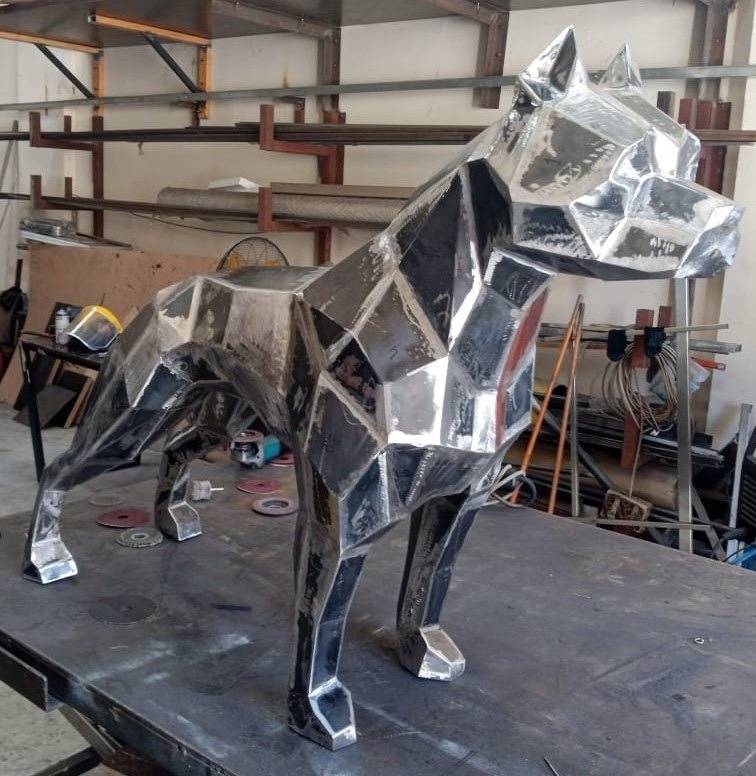 A geometric dog sculpture mid build on the workbench, raw and brushed steel panels showing the cut, fit up and weld stages.
Corrosion protection in Gulf marine conditions
Gulf marine conditions are unforgiving: salinity, humidity above 80 percent for much of the year, surface temperatures that push steel past 60 degrees, and abrasive sand in the air. Coating choice decides whether an item lasts 5 years or 25.
Atmospheric zone
C5-M epoxy systems are the baseline specification.
- Surface preparation to Sa 2.5, blast profile 50 to 85 microns
- Zinc rich primer at 60 microns dry film thickness
- Epoxy intermediate coat at 150 microns
- Polyurethane or polysiloxane topcoat at 60 microns
- Total DFT of 250 to 320 microns, measured after every coat
Splash zone
The splash zone takes the worst of it. Paint alone is not enough.
- Hot dip galvanising to ISO 1461, then a sealer coat
- Thermal spray aluminium at 200 to 300 microns with a sealer
- Neoprene or elastomer wraps on legs and bracing
- Sacrificial anodes on permanently immersed items
Galvanising thicknesses to specify
For walkways, ladders and handrails, galvanising usually beats a three coat paint system over the life of the asset. Expect a minimum of 85 microns on steel 6 mm and thicker, 55 microns on thin sections, and a sealer if the item sits near the splash zone.
Offshore steel fabrication cost in AED
Fabricated offshore structural assemblies in the UAE generally land between AED 12 and AED 22 per kg before coating and NDT. Simple plate work is cheaper. Complex nodes, lifting points and machined interfaces push the number up.
| Item | Unit | Rate (AED) |
|---|---|---|
| Plate cut, drilled and assembled | per kg | 6 to 11 |
| Fabricated offshore structural assembly | per kg | 12 to 22 |
| Blasting plus C5-M coating system | per m2 | 45 to 90 |
| Hot dip galvanising | per kg | 3.5 to 6 |
| UT or MPI per joint | per joint | 60 to 120 |
| Third party inspection attendance | per day | 1,200 to 2,200 |
Worked example: a 4 tonne access platform
Take a boat landing access platform with 4,000 kg of fabricated steel, 60 m2 of coated surface and 40 NDT joints.
- Fabrication: 4,000 kg at AED 14 per kg = AED 56,000
- Blasting and C5-M coating: 60 m2 at AED 65 per m2 = AED 3,900
- NDT: 40 joints at AED 85 per joint = AED 3,400
- Design and detailing: AED 6,000 to AED 10,000
That puts the platform at roughly AED 69,000 to AED 73,000 ex works, before transport, loadout and third party inspection. The same platform in 316 stainless for a splash zone wet area would roughly double the material element.
Lead times and capacity planning
Plan on 3 to 5 weeks for design and detailing, then 4 to 8 weeks of fabrication for a mid size scope, then coating, inspection and loadout.
- Drawing review and RFI closure, 3 to 5 days
- Detailing, shop drawings and client approval, 3 to 5 weeks
- Material purchase and mill certificate collection, 1 to 2 weeks
- Cutting, fit up and welding, 3 to 6 weeks depending on tonnage
- Blasting, coating and full cure, 1 to 2 weeks for C5-M
- NDT, dimensional check and release, 3 to 5 days
- Loadout, sea fastening and port paperwork, 3 to 7 days
Loadout is where schedules slip. If the item sails through Hamriyah or Khor Fakkan in Sharjah, or from a berth in Dubai or Abu Dhabi, book the crane and the vessel slot as soon as the fabrication start date is fixed. A 4 tonne platform moves on a lowbed or flat rack. A 40 tonne jacket section does not.
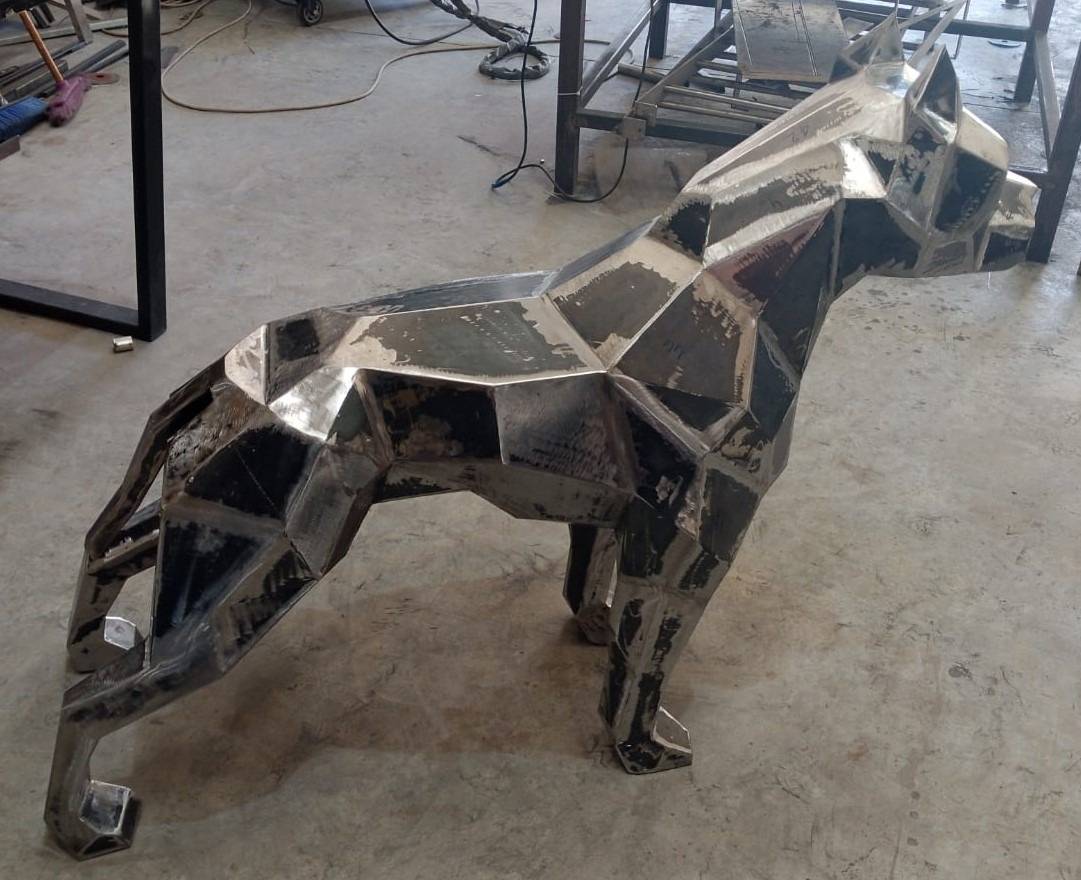 Raw polygonal form and visible weld marks on a completed geometric sculpture, the same joints we document on an offshore weld map.
QA documentation your client and the port authority will ask for
The dossier matters as much as the steel. Expect to hand over the following at release.
- Mill certificates with heat numbers matched to the weld map
- WPS, PQR and welder certificates used on the job
- NDT reports with joint numbers, technique and acceptance criteria
- Dimensional and fit up reports
- Coating DFT records with ambient and surface temperature readings
- Inspection and Test Plan signed off at every hold point
- As built drawings and a lifting point register
- Packing list and loadout plan for port clearance
DET and free zone authorities ask for different combinations depending on where the item is fabricated and where it sails from. Ports add their own permit, gate pass and lifting plan requirements. A yard that has shipped before keeps those templates ready.
How to vet an offshore steel fabricator in the UAE
Score the yard on capability before you score it on price.
- In-house blasting and coating, or a named and audited subcontractor
- Lifting capacity matched to your heaviest single piece, with certified gear
- Welder and procedure records available for review before award
- Third party inspection readiness, including access for your nominated inspector
- Vendor history with ADNOC, port operators or marine contractors
- A track record you can inspect. Start with the completed steel fabrication projects before you shortlist anyone.
Customers on the workshop floor say more than a brochure does.
I’m really happy with the work done by Apex Workshop. They are very professional, knowledgeable, and pay attention to even the smallest details. alhaf malik, 5 star Google review
Excellent works and very Proffesional team. Highly recommended. Shahad Cb, 5 star Google review
That pattern runs across 32 Google reviews and a 5.0 average.
Send drawings, plate thicknesses, coating specification and delivery port to WhatsApp +971 52 270 9796, or request an offshore steel fabrication quote and the workshop will come back with a costed scope.
Frequently asked questions
How much does offshore steel fabrication cost in the UAE?
Fabricated offshore structural assemblies typically run from AED 12 to AED 22 per kg, with blasting and C5-M coating at AED 45 to AED 90 per m2 and NDT at AED 60 to AED 120 per joint. A 4 tonne access platform with coating and inspection usually lands between AED 65,000 and AED 90,000 ex works. Transport, loadout and third party inspection are quoted separately.
Do you carry out offshore steel works in Sharjah, Dubai and Abu Dhabi?
Yes. Fabrication happens in the UAE and deliveries cover all seven emirates, including the Sharjah industrial areas, Jebel Ali in Dubai and the Abu Dhabi ports. The main differences between emirates are documentation and loadout rules, not the welding itself.
What welding standards should I specify for offshore structural steel?
Ask for EN 1090 execution class EXC2 or EXC3, welding procedures qualified to EN ISO 15614 or AWS D1.1, and welder certificates to EN ISO 9606. Full penetration butt welds on primary structure should be tested by UT, and fillet welds by MPI.
How long does offshore steel fabrication take?
Allow 3 to 5 weeks for detailing and approval, 4 to 8 weeks for fabrication on a mid size scope, 1 to 2 weeks for coating and cure, and 3 to 7 days for loadout. Add procurement time if the plate grade or section sizes are not in stock locally.
What coating system is best for offshore steel in the Gulf?
For the atmospheric zone, a C5-M epoxy system at 250 to 320 microns total dry film thickness. For walkways, ladders and handrails, hot dip galvanising to ISO 1461 at 85 microns minimum. For the splash zone, thermal spray aluminium, elastomer wraps or heavy duty epoxy with a sealer.
Can you supply mill certificates, NDT reports and third party inspection?
Yes. Every job can be released with mill certificates traced to heat numbers, WPS and PQR records, NDT reports, dimensional reports, coating DFT records and a signed Inspection and Test Plan. Client nominated third party inspectors are welcome in the workshop at any stage.